Fewer than half of frontline workers feel regularly appreciated. Those who do are five times more likely to say their wellbeing is improving, a key factor in whether employees stay with an organization. For fuel and convenience operators battling turnover, recognition is one of the most cost-effective levers available, and most teams are leaving it on the table.
If you run a fuel, convenience, or distribution business, you already know the turnover math. Drivers, delivery techs, and c-store clerks come and go, replacements cost money and time, and somewhere along the way high churn starts to feel like the cost of doing business on the frontline.
A new benchmark study suggests it doesn’t have to be.
The 2026 State of the Frontline Worker Report, produced by goHappy in partnership with Lighthouse Research & Advisory (LHRA), pairs survey data from more than 50,000 frontline workers with an independent LHRA study of 2,000 U.S. frontline workers to establish a set of market benchmarks: baseline measures of how the average frontline worker across industries experiences things like coaching, communication, and recognition. Those benchmarks matter, because they show what frontline life looks like across the broader market, not just inside any one company. And one finding stands out for anyone trying to hold onto good people.
The number most operators miss
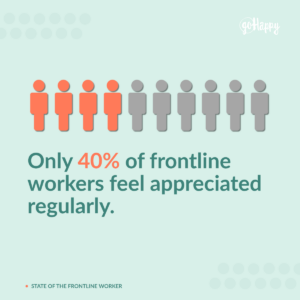
One of those benchmarks measures appreciation. Across the market, only about 40% of frontline workers say they feel appreciated on a regular basis. Six in ten workers are showing up, doing the work, and not hearing that their effort mattered.
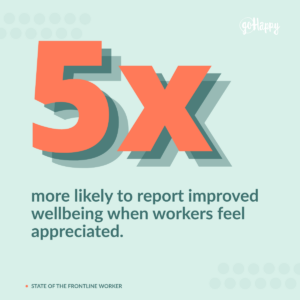
Here’s why that disconnect goes beyond morale: workers who feel accepted, respected, and appreciated are five times more likely to report that their overall wellbeing has improved. That’s the difference between a team that stays and grows and a team that quietly updates its resumes.
Appreciation, in other words, is a multiplier. It’s one of the lowest-cost inputs a leader controls, and it tracks with some of the highest-value outcomes a business cares about.
Appreciation isn’t a program, it’s a behavior
When faced with data like this, the instinct is to go build something: a recognition program, a points system, an employee-of-the-month plaque for the break room. Those can help, but the research points to something simpler.
The State of the Frontline Worker Report found that more than half of workers who feel unappreciated only receive feedback once a year, or never. The problem isn’t that companies lack a recognition initiative; it’s that meaningful, specific acknowledgment happens too rarely to register.
Appreciation that shows up once a quarter reads as an event. Appreciation that shows up in the small moments—the driver who handled a tough delivery in bad weather, the clerk who covered an open shift without being asked—reads as culture. The behavior is free. The consistency is the hard part.
The catch: reaching people who aren’t at a desk
For frontline businesses, consistency runs into a practical wall. Your people aren’t sitting at computers checking email between tasks. They’re behind the wheel, on the lot, or running a register across a dozen locations. The appreciation a leader genuinely feels often never makes it to the person who earned it, because there’s no reliable way to get it there.
This is where good intentions run into the real challenge: getting through to people you rarely see at a desk. A shout-out that lives in a leader’s head, or in a meeting that half the team missed, doesn’t move the needle. One that reaches the overnight clerk or the tank-wagon driver the same day it’s earned does.
For teams spread across stores, terminals, and routes, that usually means meeting people where they already are: their phone. Solutions built for deskless teams, goHappy among them, let leaders send recognition by text so it lands with every team member the same day, no app to download and no company email required. The tool carries the message. Recognition is most powerful in the moment. Instant praise helps employees feel seen and appreciated for the work they’re doing, right when they’re doing it.
There’s a fairness angle here, too. The report found that frontline workers are twice as likely to recommend their employer as a great place to work when they feel they’re treated equitably with the rest of the organization. Consistent recognition is one of the clearest signals that the people doing the hardest jobs are seen and valued, which shapes not just who stays, but who wants to join.
Where to start this week
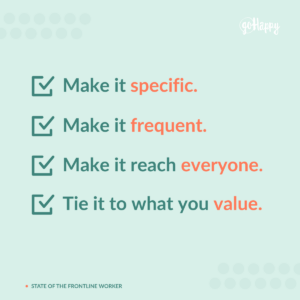
The good news: you don’t need a budget line to act. Here’s how to make recognition more meaningful:
- Make it specific. “Thanks for your hard work” fades fast. “The way you handled that delivery in the storm Tuesday kept a customer for us” sticks, because the person knows you saw it.
- Make it frequent. Aim for recognition in the flow of the week, not the calendar quarter. Frequency is what turns a nice gesture into a felt culture.
- Make sure it reaches everyone. Recognition that only lands with the people in the room misses most of a distributed frontline team. Pick a channel that reaches drivers and clerks where they are.
- Tie it to what you value. When you recognize the behaviors that reflect your company’s values, you teach the whole team what “great” looks like here.
The bottom line
Here’s the math that makes recognition an easy call. Replacing a frontline worker costs real money: SHRM estimates around $4,700 for every departure, and broader estimates put it at roughly one-third to one-half of the person’s annual salary. Multiply that across a year of driver, delivery, and c-store turnover and the number grows exponentially.
Now weigh that against the cost of telling someone their work mattered. Specific, in-the-moment recognition is free. It takes a leader a few seconds and they have now made a genuine connection with the person. Few retention levers cost so little and return so much, and it feeds the chain the report lays out: stronger engagement leads to stronger intent to stay, and stronger intent to stay leaders to lower turnover.
The business case for engaging frontline teams is no longer theoretical. Appreciation is the most affordable place to start, and the operators who treat it as a daily behavior, not an annual event, are the ones whose people stay.
The appreciation gap is one of four leadership behaviors the data flags as separating higher-performing operators from the rest. You can explore the full findings, including breakouts for retail, transportation, and other frontline industries, in the 2026 State of the Frontline Worker Report from goHappy and Lighthouse Research & Advisory.
Want to see how goHappy helps operators get recognition through to every frontline worker, even the ones without an email address? Connect with the team for a 30-minute walkthrough.