
Here’s what every fuel marketer should know before trusting a processor’s headline rate.
When you ask a payment processor for their best pricing, you’ll almost always hear the same pitch: “interchange-plus.” It sounds fair. You pay the card networks’ actual cost, plus a small markup for the processor, and that’s it. Chase the lowest markup, the thinking goes, and you’ve got the best deal.
For a lot of fuel marketers, that thinking quietly costs them tens of thousands of dollars a year.
Here’s the one thing to take away: stop shopping for the lowest advertised rate and start measuring the only number that counts: your all-in effective rate.
Why does the headline rate mislead? The markup is only one line on your statement. Underneath it sits a long list of small charges most operators never read: monthly service fees, batch fees, authorization fees, address-verification fees on every card run, statement fees, and more. No single one looks big. Stacked together, month after month, they add up to real money.
Fuel marketers feel this more than most. Your card mix leans heavily toward fleet, business, and commercial cards. Those are the highest-cost categories and the ones with the most room for a processor to tuck in markup you’ll never notice. Add high average tickets and steady monthly volume, and even a fraction of a point of hidden cost turns into a five-figure leak by year’s end.
The only number that matters
Forget the advertised rate. The number that tells you the truth is your effective rate: every fee you paid in a month divided by your total card volume. A “low” markup means nothing if three dozen other line items push your real cost to 5% of everything you run. For a card mix like the one below, anything above roughly 3.5% deserves a hard look, and 5.66% is alarm-bell territory.
One note before the numbers: this example is card-not-present volume, the online and phone payments where the card isn’t physically swiped, dipped, or tapped. That distinction matters, and we’ll come back to it. We recently looked at a statement from a large-ticket B2B merchant of exactly this type. In one month, they ran about $1,435,000 across 462 transactions. Their total fees came to $81,224.50, an effective rate of 5.66%. So much for “low and transparent.” Here’s how that broke down:
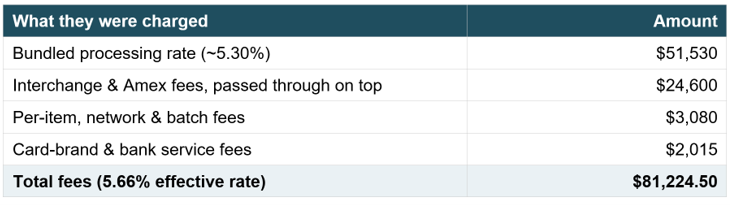
Two details made it worse. There was a $495 annual fee, a charge just for being a customer. And buried in the fine print on the last page was a notice that rates were going up “to offset rising costs,” with another increase already scheduled for the following month.
A simpler model that actually saves money
There’s a more straightforward way to price card acceptance, called tiered pricing. Instead of hundreds of moving parts, it sorts every transaction into a few simple buckets, each with its own rate. For example, one rate for debit cards, a standard rate for consumer credit cards, and a higher rate for business and commercial cards.
We ran that same merchant’s exact month through a transparent tiered schedule: 2.50% on debit, 2.95% on consumer credit, and 3.50% on business and commercial cards, plus a flat 30 cents per transaction.
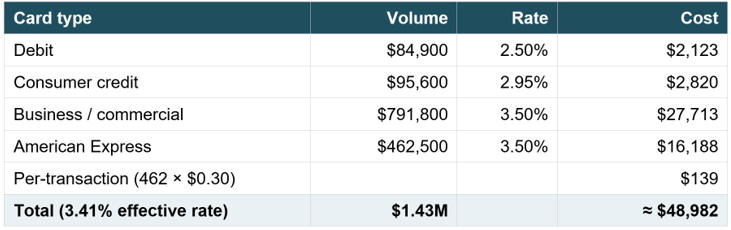
That’s an effective rate of about 3.41%, versus the 5.66% they were actually paying. The difference is roughly $32,200 a month, or close to $387,000 a year, on a single location’s volume.
Where does the savings come from? It isn’t magic. It comes from replacing a tangled, unverifiable fee structure with three rates and one per-transaction charge that anyone can check in about a minute.
Why simple usually wins
You can actually check the bill. To verify a tiered statement, you multiply the rate by the volume in each bucket. Your bookkeeper can confirm it in thirty seconds, and any overcharge jumps right out. To verify an interchange-plus statement, you’d need to confirm the correct category for every single transaction, and there are hundreds of categories across the card networks, each with its own rate and rules. No merchant has the tools to do that. Transparency you can’t check isn’t transparency. It’s trust.
Your costs stay predictable. A tiered or flat program produces a number that barely moves month to month, so your budgeting stays accurate. Interchange-plus swings with your card mix, and because nobody audits the underlying costs, the markup can quietly drift too.
Picture two months with identical sales but a different card mix. Under interchange-plus your processing cost can move by thousands, and you won’t know why until the statement lands. For an operator who wants a clean, forecastable P&L, that unpredictability is a cost of its own, one that never shows up as a line item.
The honest exception
Here’s where card-present matters. When a customer swipes, dips, or taps a card at the pump or in the store, the transaction qualifies for lower interchange than the same card run online. For that card-present volume, a clean interchange-plus deal with a small markup and no junk fees will usually beat a tiered rate. The example above is the opposite case: card-not-present volume, where interchange runs higher and a stacked, unverifiable program has the most room to pad the bill.
It can also win for a debit-heavy business, or any genuinely clean deal with a tiny markup and none of the monthly, statement, or batch junk fees. The villain here isn’t interchange itself. It’s the stacking of fees, the categories no one can verify, and the quiet rate creep on top. The name of the pricing model tells you almost nothing about what you’ll actually pay. Only the all-in effective rate does.
One more lever: surcharging
There’s an even bigger opportunity for many operators. With credit card surcharging, you pass part of the card fee to the customer who chooses to pay by credit. The rules vary by state, and debit is excluded, but the upside is large. Here’s that same month with surcharging applied to the tiered program:
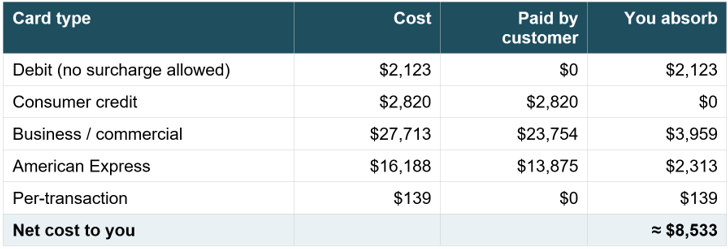
That drops the merchant’s cost to just $8,533, an effective rate of 0.59%, and a net savings of about $72,700 a month, or roughly $872,000 a year, on one location.
Done right, surcharging is straightforward: you post clear signage at the point of sale, cap the surcharge at your actual cost of acceptance, never apply it to debit, and follow your state’s rules. A processor who knows the fuel business will set this up so you stay compliant while recovering most of your credit card cost, not bolt it on and leave you exposed.
The bottom line
Don’t judge a processor by its headline rate or the model it’s branded with. Pull your most recent statement and ask two questions.
- What’s my all-in effective rate? Add up every charge and divide by your volume. The merchant above thought they had a great deal, but the math said 5.66%.
- Can I check the bill myself? If verifying it takes expertise you don’t have, you’re not buying transparency. You’re buying trust, and you should price it accordingly.
A simple, honest tiered or flat program wins more often than the industry’s favorite buzzword would have you believe.
Want to know your real effective rate? Send us your statement and we’ll do the math for you. No jargon, no obligation.