
Every fall, frontline teams go through the same whiplash. The summer crew heads back to school right as the calendar turns toward the busiest stretch of the year. Here’s the uncomfortable part: the more you’ve invested in someone, the more their resignation costs you. Industries that do the most to develop their people (certification, apprenticeships, safety training) carry the most exposure when those people leave. The investment only pays if you keep them. Hiring stops being a quarterly task and becomes a daily scramble.
The stakes are higher than the headcount suggests. According to the 2026 State of the Frontline Worker Report from goHappy and Lighthouse Research & Advisory, frontline turnover runs steep across customer-facing industries, with retail near 103% and food service near 100%. At those rates, many operations effectively replace their entire frontline team inside a year. The report also points to a SHRM estimate that puts the average cost to replace a single hire at roughly $4,700. Looked at from the other direction, the report models what holding onto people is worth: a ten-point improvement in retention adds up to about $235,000 a year for a 500-person operation, and roughly $470,000 for one with 1,000 workers on the payroll.
So the real question this time of year is not only how to fill the roles. It’s how to fill them with people who will stay.
H2: The Best Candidates Are Already One Conversation Away
Hiring has always carried a cost. But in an environment where nearly every operating expense is climbing, the cost of hiring someone only to replace them a few weeks or months later is harder to absorb. That makes retention part of the hiring equation from day one.
When a role opens, most organizations reach for the same familiar tools: job boards, staffing agencies, and “now hiring” signs. These channels have their place, but one of the most cost-efficient recruiting channels is already standing behind the counter.
Frontline team members know people who would be strong candidates, including plenty who are not actively scrolling job boards. And when employees are willing to put their name behind someone, organizations gain more than another applicant. They gain a candidate who comes with context about the job, the workplace, and what it takes to succeed there.
The research consistently points to several advantages:
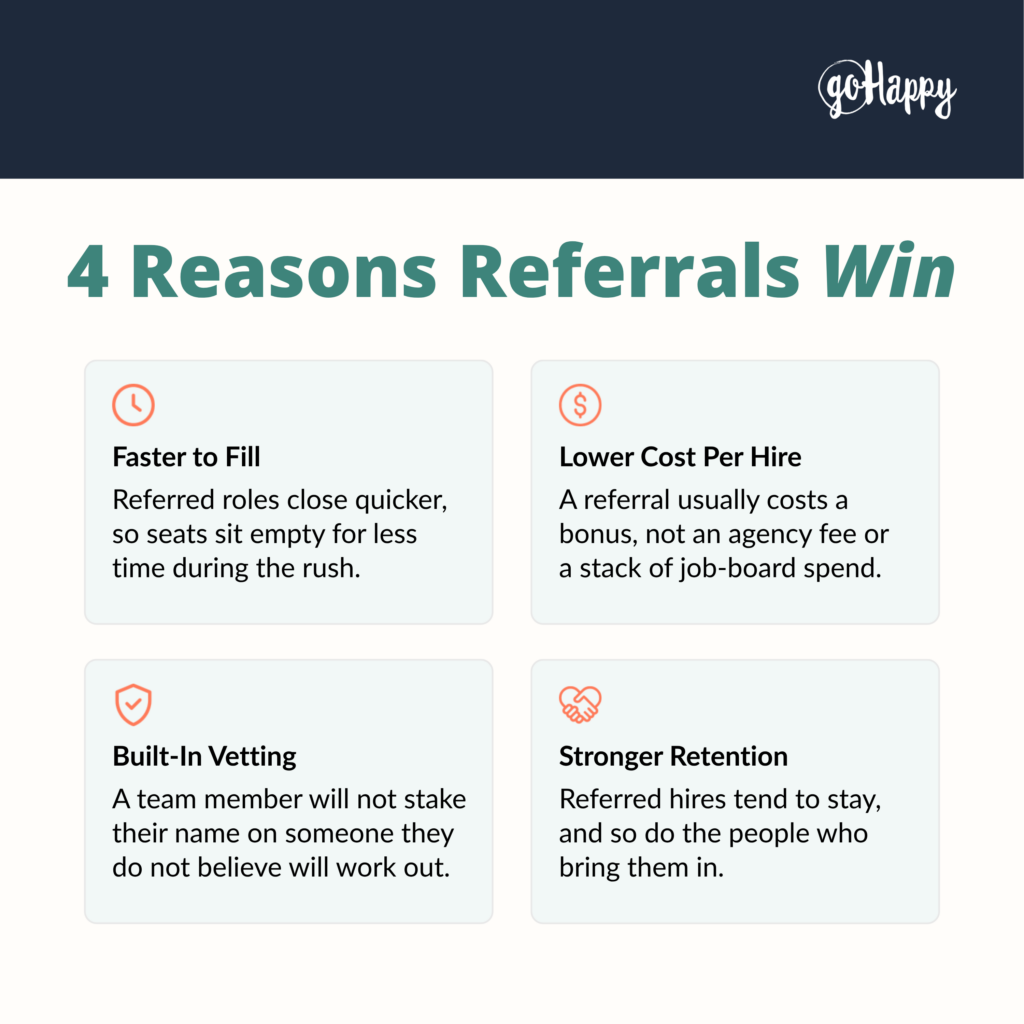
- Speed: Referred candidates are hired in 29 days on average, compared with roughly 44 days through other channels, shortening the time a role sits vacant.
- Cost: Employers save well over $1,000 per hire by sourcing through referrals rather than relying exclusively on paid channels.
- Built-in vetting: Employees have a stake in whom they recommend. Their own reputation is attached to the referral, creating an additional layer of screening before a candidate ever applies.
- Reach: Referrals account for 30 to 50% of hires at many organizations, even though they represent a small share of total applications.
There is a simple story that captures the opportunity. In an SG Voices webinar earlier this year, Laura Varn, former VP at Parkland Fuel Corp., described a stay interview she conducted on the floor. She mentioned the company’s referral program to a team member who had no idea it existed. The next day, he sent over five names. Four were hired.
The talent was there the whole time. Someone just needed to ask.
H2: The Real Value of a Referral Shows Up After the Hire
Getting someone through the door is only part of the challenge. The more expensive problem is getting them through the door, investing in recruiting, onboarding, training, and manager time, and then starting over when they leave.
That is especially important in frontline environments, where organizations may find themselves filling the same high-turnover roles again and again. The easiest vacancy to manage is the one you do not need to refill.
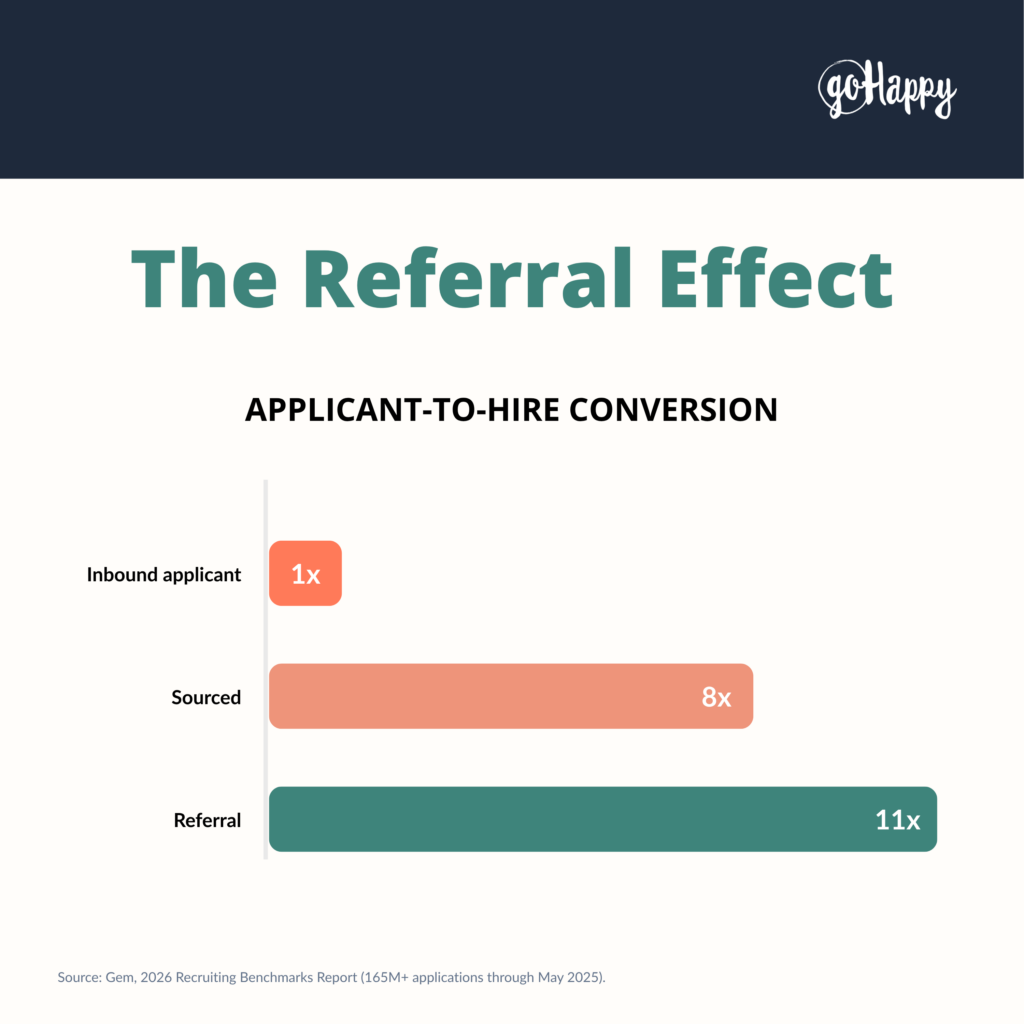
Gem’s 2026 Recruiting Benchmarks Report, based on more than 165 million applications through mid-2025, found that referred candidates convert to hires at about 11 times the rate of general applicants. Job boards may generate enormous application volume, but referrals represent a much smaller portion of the pipeline while producing an outsized share of actual hires.
And the advantage does not end once someone accepts the job. A randomized controlled trial published by the National Bureau of Economic Research, conducted across stores in a large European retail chain, found that referred hires had roughly 40% lower attrition than comparable non-referred hires. Even more striking, introducing an employee referral program reduced overall store turnover by about 15%, with the effect persisting for more than a year.
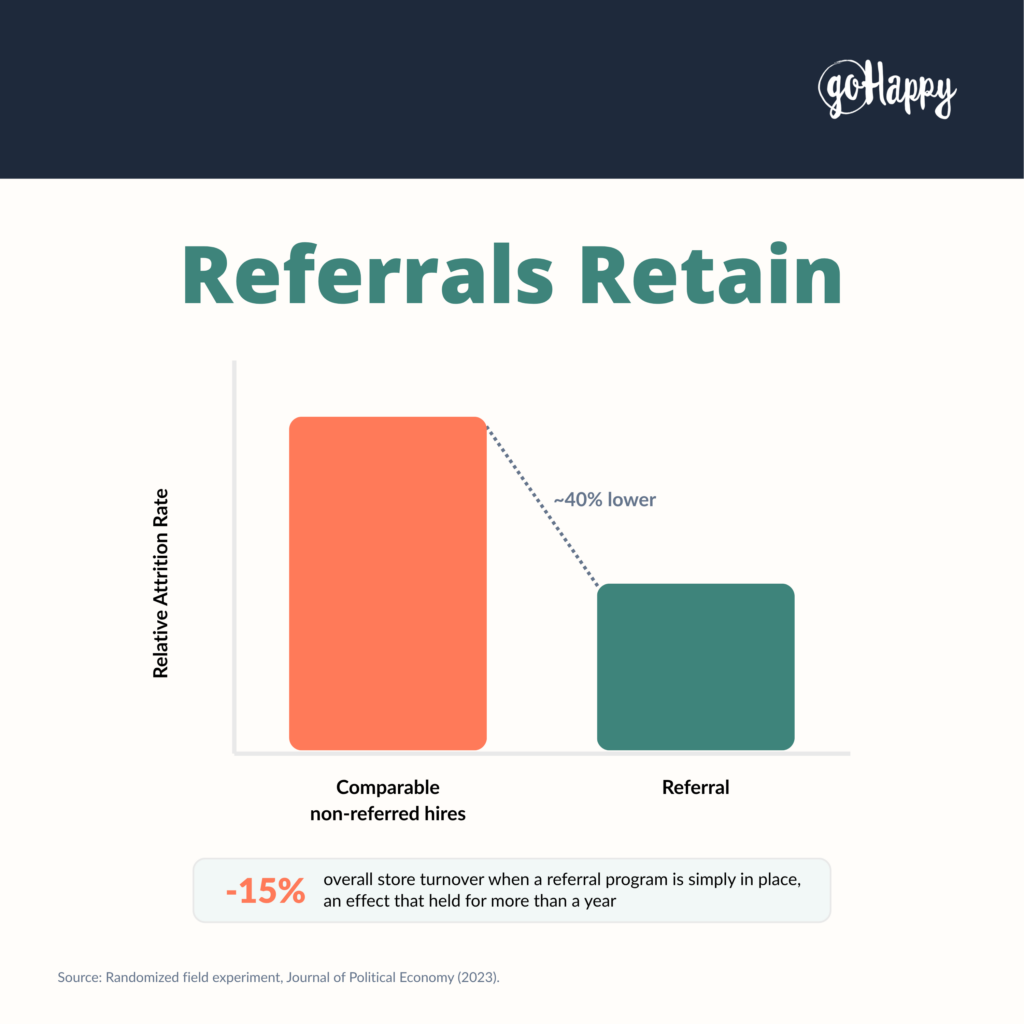
The benefit was not limited to the new employees who came in through referrals. In that same experiment, turnover fell across the store. Giving employees a role in building that team may strengthen their connection to it, too.
A referral is a small act of ownership. It says, “I want to be a part of building this community.”
H2: Turn Referrals Into an Always-On Recruiting Channel
For organizations across c-stores, fuel, and propane operations that regularly need to fill critical frontline positions, referrals shouldn’t be something managers only remember when hiring gets difficult. They work best when they become part of the normal rhythm of workforce management.
- Ask the question out loud, and often. Employees may not know a referral program exists, or they may have forgotten about it. Regular reminders that you’re looking for good candidates can help keep referrals top of mind.
- Remove the friction. The lighter the lift to refer someone, the more referrals you get. Complicated forms quietly kill participation.
- Focus referrals where turnover costs the most. Look at roles you’re constantly refilling, positions that take unusually long to hire for, or jobs where early-tenure turnover is highest. These are natural places to build a stronger referral pipeline.
- Protect the culture that fuels referrals. Employees will recommend people they care about only when they feel comfortable recommending the workplace itself. Recognition, communication, and fair treatment are what make people feel good about where they work.
In a higher-cost environment, organizations cannot control every expense. But they can get more intentional about the cost of repeatedly recruiting, hiring, and training people for the same positions. That makes the goal bigger than filling the next opening. It is finding people who are more likely to succeed, stay, and become the person making the next referral.
For many organizations, your best recruiters are already on the schedule. Sometimes, all it takes is asking.