Depending on where you look, you can find proof of economic strength or stress. We explore this two-faced nature and why it matters.
Pringles are the most interesting snack at the convenience store. And it’s not just because they’re tasty.
Picture the shape of an individual chip. It looks like a saddle. From front to back, it slopes upward at the edges. But from side to side, it does the opposite, sloping down. That shape is called a hyperbolic paraboloid (though we’ll just stick with “Pringle”). And it’s a fitting image for the American economy right now.
Every month, Upside analyzes transaction data from more than 20,000 fuel stations and convenience stores. Depending on which numbers we magnify, we can tell you two very different stories. The first says that consumers are stretched thin and pulling back. The other says they’re still showing up, still spending, still finding ways to make it work.
Neither is wrong, and both are true. That’s fragile resilience: the idea that we’re experiencing both positive and negative trends at the same time. These trends form a single shape that bends two ways.
For fuel and convenience retailers, the fragile side explains why every trip feels harder to win. The resilient side is where the opportunity still is. Here’s what the data shows, and what it means for your business.
Fragile: Incomes are flat
Resilience: Spending keeps climbing
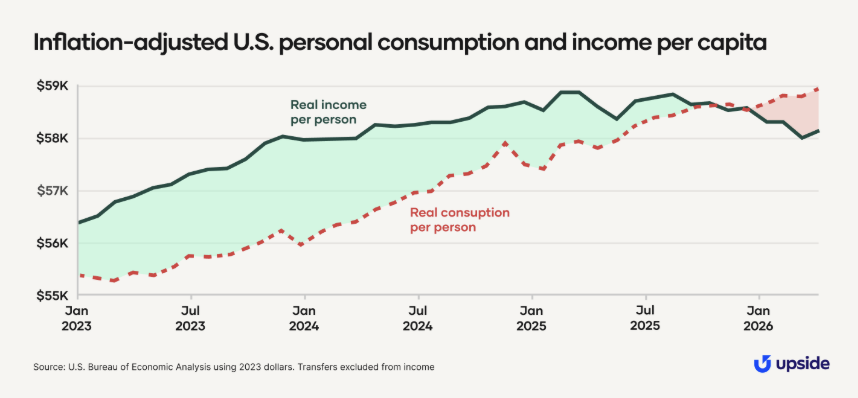
From 2023 through 2025, inflation-adjusted income per person rose steadily. It peaked in early 2025, and ever since, it’s been drifting downward. As consumer purchasing power decreases, individuals feel more pressure to provide for their households.
You might expect that spending would follow suit, declining in turn. But that hasn’t happened — spending has continued to increase. In 2026, for the first time in our data series, real consumption is outpacing real income. Consumers are still buying, even if their paychecks aren’t supporting that behavior. This means consumers are either dipping into savings or taking on debt to maintain their lifestyles.
Fragile: Consumers are shifting behavior amid high prices
Resilience: Demand is relatively stable, both inside and outside
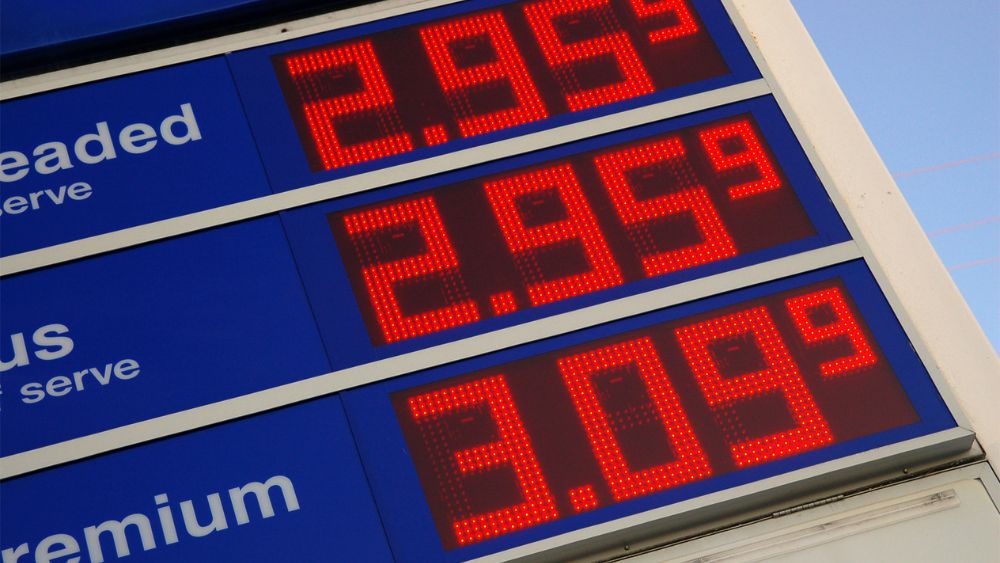
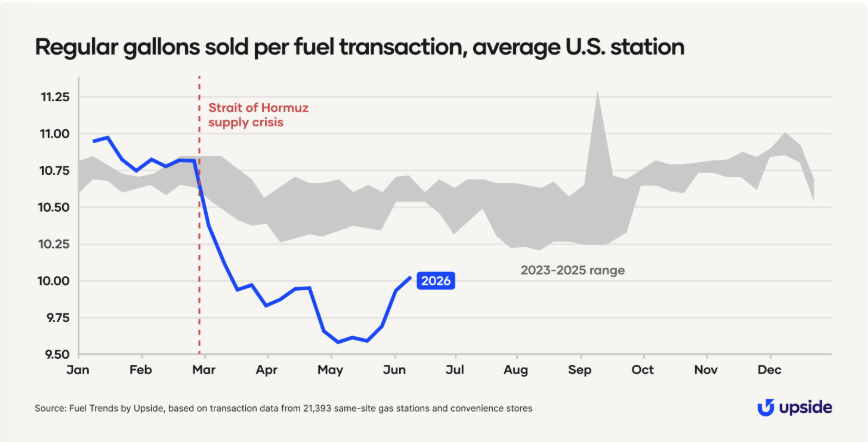
This year has given the fuel industry a real stress test. When gas prices spiked in the spring, consumers shifted their behavior to protect their budgets. Instead of driving until their tank ran empty and then re-filling it, drivers instead visited the gas station more often for smaller transactions.
The average gallons sold per fuel transaction dropped from a typical range near 10.75 gallons down to roughly 9.6 gallons by May. This shift protected cash flow and reduced the sticker shock of each trip to the pump.
We noticed something similar happened inside the store. As gas prices spiked, c-store items per transaction dipped below their normal levels.
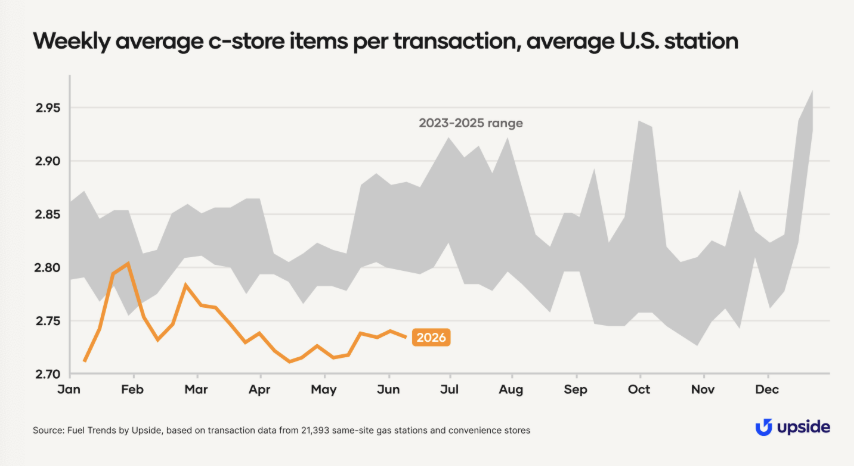
That’s the fragility side of the story. But at the same time, fuel demand never fully collapsed. Compared to previous years, it’s down 4.7% per station per day since the start of the crisis. That’s not as much as it could be, though, because of the enormous supply shock we’re still working through. Given the circumstances, these demand figures are relatively encouraging.
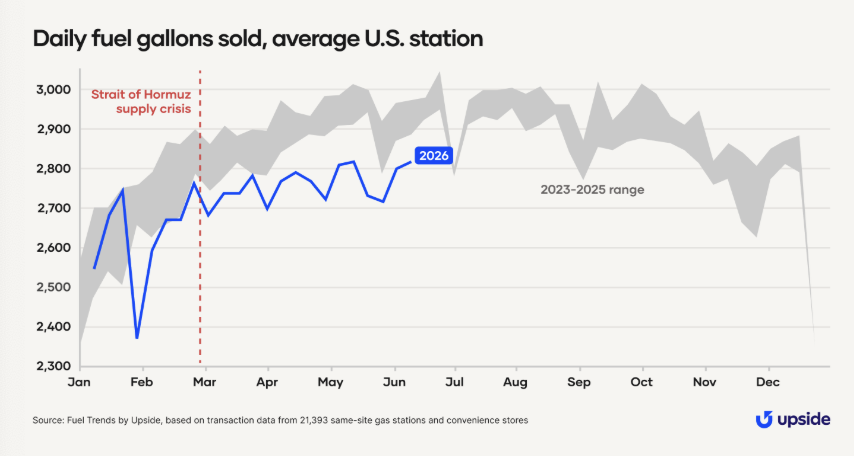
Part of that is because people don’t put their lives on hold when gas prices increase. They still have daily obligations — commutes to work, pickups from school, leisure trips on the weekend. Though consumers changed how they bought fuel, they didn’t stop buying it.
Inside the store, demand is holding up even better than it is in the forecourt.
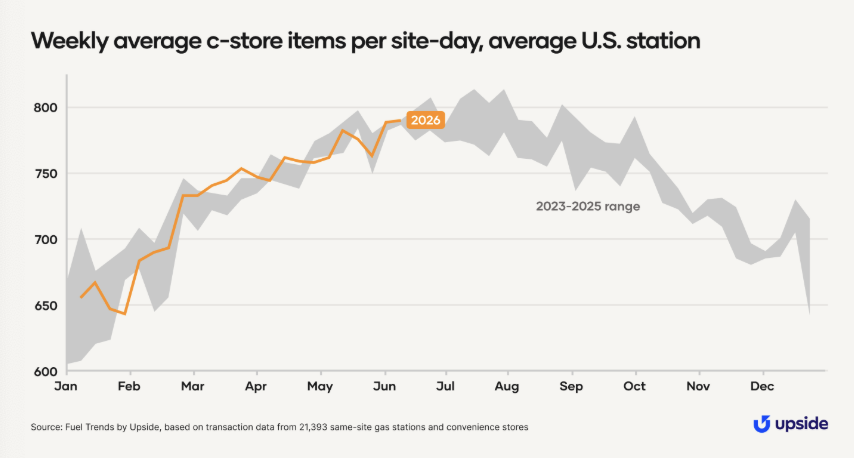
All year long, the average c-store’s daily sales have been 6.8% higher per store from the previous three-year average. Even as baskets shrink, the increase in trips is delivering benefits to retailers. Fewer items per trip, but more trips overall, adds up to real, measurable growth.
Fragile: Fuel consumers are cross-shopping.
Resilience: Foot traffic is strong, and trips are up-for-grabs.
The past few years have been marked by the rise of the uncommitted customer. These are individuals who put the value they receive from any given transaction ahead of brand loyalty. They compare their options before beginning their trip and spread their transactions across numerous retailers and brands in order to maximize their own return.
Uncommitted customers make up nearly 75% of fuel and c-store consumers today. In 2025, the average consumer bought fuel at 2.6 different gas stations a month, a figure that was up 7% year-over-year. They also shopped at 3.2 different convenience stores a month, up 17% over the same period.
That’s a strong indictment of the state of brand loyalty. But remember how high gas prices are pushing consumers to make fuel trips more often? A more optimistic reading of this data is that retailers have more opportunities than ever to win over customers. In 2026, both fuel and c-store visits per site have been trending at or above their three-year ranges in 2026.
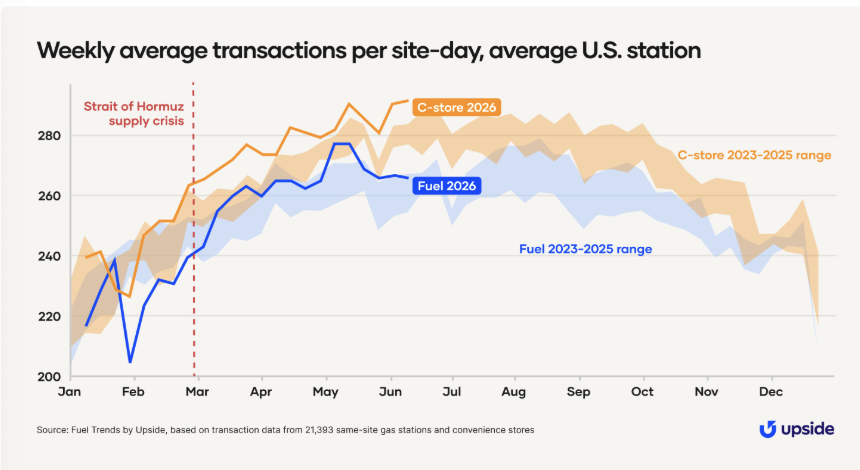
Consumers are on the hunt for value, and they’ve shown that they’ll change where they transact in order to get it. “Value” can mean different things to different people; it’s not just about price, but about the balance of price, quality, and convenience.
With foot traffic strong, retailers have more opportunities than ever to impress customers and begin the process of earning their long-term loyalty.
What does this mean for retailers?
We recently surveyed consumers about their spending habits, and one individual put it simply: “I have to shop at several stores to try and make ends meet. I’m spending more money but getting less food.” That’s fragile resilience in one sentence — someone still spending, but doing the math differently than they used to.
Let’s return to the image of the Pringle. The mistake is looking at your data from one angle and calling it a downward slope, or looking from the other and calling it an upward one. It’s both, at the same time, and the shape only makes sense when you hold the whole thing.
This is the best way to describe this economic environment.
For fuel and c-store retailers, the takeaway isn’t to wait for conditions to get easier. It’s to meet consumers at their unique value points, with an offer meaningful enough to influence a visit but profitable enough to continue growing the business.
Consumers are recalculating, trip by trip, who earns their business next. It’s up to the retailer to stand out from the pack and win that next trip repeatedly.