By John McCauley, Partner and Director of Brand Design
Large convenience chains have deep pockets. They have sophisticated loyalty programs, national marketing budgets, and supply chains that can source virtually anything at scale. But there is one thing they cannot buy, cannot manufacture, and absolutely cannot fake: a genuine connection to the community they serve.
For small regional operators and independent c-store owners, that connection is not just a nice story to tell. It is your most powerful differentiator, and you cannot lean into it hard enough.
Frank Gleeson, NACS president and CEO, put it plainly: “Convenience stores are deeply rooted in their local communities. It’s important to remember that for some of your customers, a team member may be their only point of human interaction that day. Human connection will always be our competitive advantage.” That truth applies with even greater force to the independent operator who lives in the same town, coaches the same youth soccer league, and knows half their customers by name.
So, the question is not whether community connection matters; the question is whether you are building it intentionally, or leaving it on the table.
Make the Store a Reflection of Where You Are
Design is one of the most direct and lasting ways to signal to your customers that this store belongs to them. Murals that celebrate local landmarks, photography that tells the story of your region, and graphics that speak to local identity all communicate something a national chain simply cannot: we are from here.
Community bulletin boards are another underutilized tool. A board dedicated to local events, school fundraisers, and neighborhood announcements sends a quiet but powerful message that you see your store as more than a transaction point. It is a hub.
For stores with deep roots in their community, a brand history timeline can be one of the most powerful design elements in the space. Many independent and regional operators have multi-generational stories going back decades. Telling that story visually, through photography, key dates, and milestones installed prominently in the store, communicates community rootedness at a glance. Customers who grew up in the area will recognize the history, and newer customers will understand immediately that this is not a chain that arrived last year. That kind of longevity is a form of trust, and design can put it on display.
Brand messaging within the space can go even further. Regional taglines, expressions of local pride (“Made in Maine,” for example), and being overt about local ownership give your brand a voice that resonates with customers for whom place and authenticity genuinely matter. Sometimes the store name itself can carry that localization message. Do not underestimate what it means to a customer to walk into a store that feels like home.
These are not decorative decisions. They are strategic ones. Customers who feel a genuine sense of place become advocates. They come back when something shinier opens nearby, because emotional loyalty is stickier than rational loyalty. You do not switch away from a place that feels like yours just because a new location has better lighting.
Source Locally and Say So
Product selection is another dimension where small operators have a real edge. When you stock coffee beans from a local roaster, beer from a nearby brewery, or baked goods from a neighborhood bakery, you are doing something a national chain cannot match at scale. And when you tell that story on your shelves, on your menu boards, and through your team, it becomes a point of genuine pride for the customer.
Locally sourced, signature products are not just a nice touch. They create the kind of loyalty that transcends price. Customers who care about supporting local businesses will choose you specifically because of those relationships, not in spite of anything else. Done well, that connection can turn occasional shoppers into something far more valuable: super fans who return often, spend more, and become genuine ambassadors for your brand in the community.
Extend Your Brand Into the Community
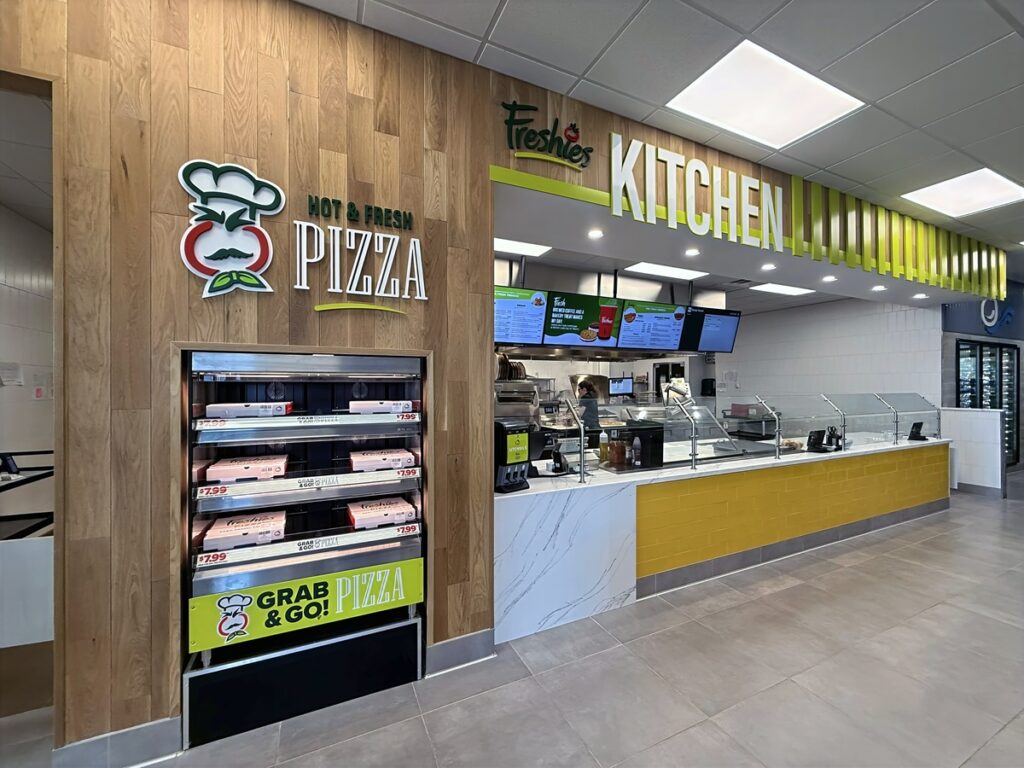
Community connection does not stop at the front door. How you show up outside the store matters just as much. Freshies, a Paragon client in Maine, operates a wood-burning pizza program under their own brand that serves local events throughout their region. It is a remarkable example of a c-store extending its identity into the life of its community in a way that is both memorable and genuinely useful.
Freshies
Sponsoring local sports teams, participating in area charities, and supporting community events create visibility and goodwill that no media buy can replicate. These touchpoints build the kind of affection that keeps customers coming back not just out of habit, but out of genuine allegiance.
Embrace What Only You Can Own
None of this works without a foundation of consistency. Community connection is not a substitute for operational discipline. A locally sourced product that is always out of stock, or a community mural in a store that is not well maintained, sends the wrong message entirely. Consistency is what makes the rest of it land. It is what builds trust, and trust is what loyalty is built on.
At Paragon, we work with convenience store operators across the country, and we see this repeatedly: the operators who thrive long-term are the ones who understand what makes them irreplaceable. A national chain can match your price. They can match your coffee program. They cannot match your story, your roots, or your relationships.
Embrace your uniqueness. Build it into every corner of your store, every product on your shelf, and every event you support. That is the differentiation that no competitor can walk in and take away from you.