The concept of hedging often appears daunting to companies approaching it for the first time. They might think perhaps it’s too complex or it’s only for larger businesses. This isn’t true now and it wasn’t true back in the late 1970’s when the world’s first successful energy futures contract was traded on the New York Mercantile Exchange. Home heating oil dealers were some of the early adopters and they have been market participants ever since.
At its simplest, hedging is a strategy used to manage the risk of adverse price movements impacting the bottom line. The goal of hedging is to defend your profit margin against energy price volatility and allow you to concentrate on growing your business.
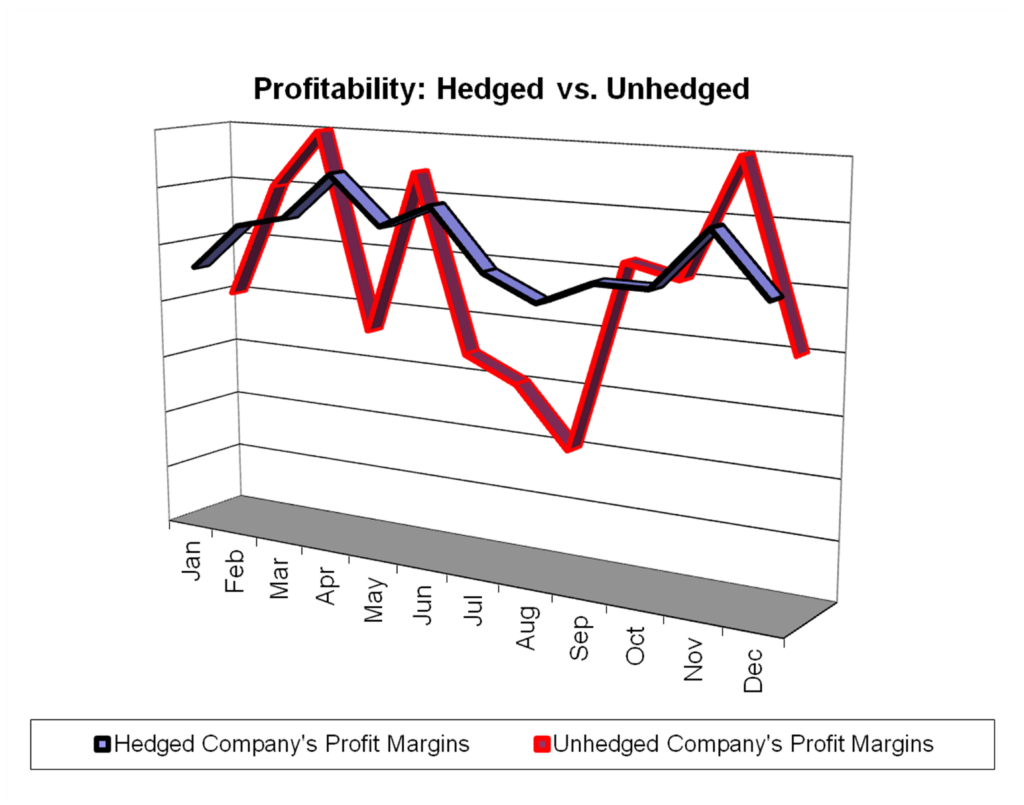
Companies employ hedging strategies to help:
1. Stabilize profit margins
2. Protect the value of product in storage
3. Protect the value of product in transit
- Pipeline
- Railcar
- Barge
4. Keep company fuel costs within a budget
5. Differentiate their business from the competition
- Fixed price offerings to your customers
- Capped price offerings for your customers
6. Take advantage of market opportunities
- Carry markets (storage trade)
- Regional differences in price (basis trade)
Savvy fuel marketers turn market instability into opportunity. No one likes dealing with expensive uncertainty. Many buyers like the fixed price because it allows them to know their fuel budget in advance. Fuel buyers often look to their suppliers for help with market volatility. A fuel marketer that can address these concerns creates a much deeper business relationship with their clients.
Competition and volatility are not ‘bugs’ in the system. They are regular features. Successful businesses continually seek to add to their intellectual capital. POWERHOUSE is ready to help you take the next step.
Disclaimer:
This material has been prepared by a sales or trading employee or agent of Powerhouse Brokers, LLC and is, or is in the nature of, a solicitation. This material is not a research report prepared by Powerhouse Brokers, LLC. By accepting this communication, you agree that you are an experienced user of the futures markets, capable of making independent trading decisions, and agree that you are not, and will not, rely solely on this communication in making trading decisions.
DISTRIBUTION IN SOME JURISDICTIONS MAY BE PROHIBITED OR RESTRICTED BY LAW. PERSONS IN POSSESSION OF THIS COMMUNICATION INDIRECTLY SHOULD INFORM THEMSELVES ABOUT AND OBSERVE ANY SUCH PROHIBITION OR RESTRICTIONS. TO THE EXTENT THAT YOU HAVE RECEIVED THIS COMMUNICATION INDIRECTLY AND SOLICITATIONS ARE PROHIBITED IN YOUR JURISDICTION WITHOUT REGISTRATION, THE MARKET COMMENTARY IN THIS COMMUNICATION SHOULD NOT BE CONSIDERED A SOLICITATION.
The risk of loss in trading futures and/or options is substantial and each investor and/or trader must consider whether this is a suitable investment. Past performance, whether actual or indicated by simulated historical tests of strategies, is not indicative of future results. Trading advice is based on information taken from trades and statistical services and other sources that Powerhouse Brokers, LLC believes are reliable. We do not guarantee that such information is accurate or complete and it should not be relied upon as such. Trading advice reflects our good faith judgment at a specific time and is subject to change without notice. There is no guarantee that the advice we give will result in profitable trades.