After every Study Groups meeting, participants are asked to reflect on where they found the most value during the two or more days spent together. Across groups of 8–15 industry peers, the feedback has been remarkably consistent: open group discussion is cited as the most valuable element by a wide margin.
Over the past year alone, Study Groups members collectively spent more than 2,000 hours engaged in open discussions across more than 180 meetings.
These group discussions are especially valuable because they occur in a trusted environment among peers who become friends, and because they revolve around each leader’s specific Burning Issues, Recent Activities, and Best Ideas. This identical meeting cadence across all groups provides a unique opportunity to observe common challenges, initiatives, and creative solutions leaders are working through in real time. The insights that follow are drawn from the last Study Group meeting of all groups in 2025.
Burning Issues Across Study Groups
In-person discussion of burning issues remains a valuable opportunity for leaders to bring their most pressing challenges to a trusted group of experienced peers. The following insights summarize the most common burning issues raised across all Study Groups meetings.
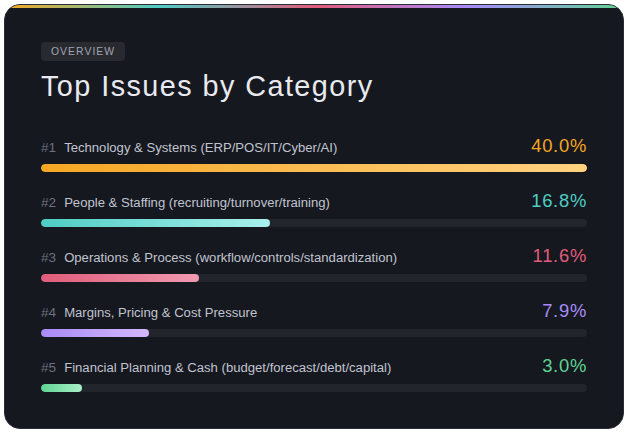
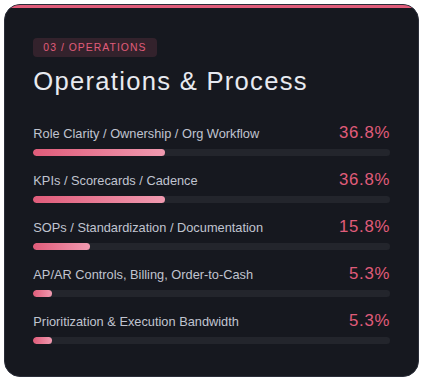
Nearly 70% of all burning issues fall within the top three categories. A closer look at these areas provides deeper insight into the pressures leaders are facing.
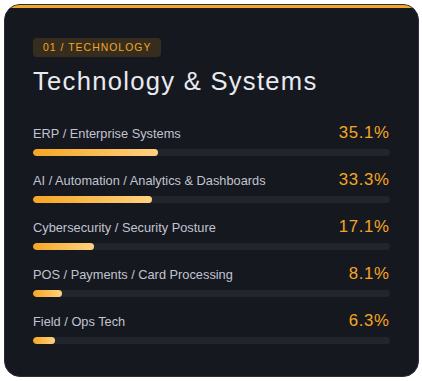
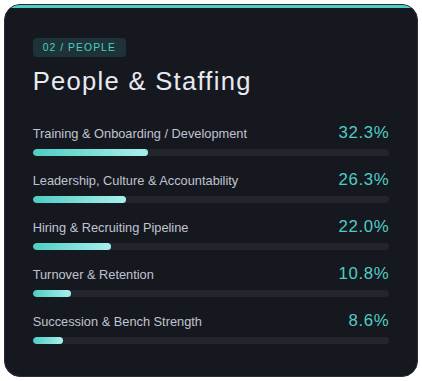
Technology: From Opportunity to Strain
Technology is increasingly described as a source of organizational drag and fatigue. Leaders frequently point to large-scale system transitions that extend over multiple years, leaving teams in prolonged states of uncertainty. In many cases, planned improvements have stalled because foundational systems were never fully stabilized, leading to lost momentum.
These disruptions are not purely technical. Leaders note downstream impacts on morale, turnover, and organizational confidence. At the same time, artificial intelligence has emerged as both an area of experimentation and a source of unease. While many organizations are actively exploring AI tools, there is widespread uncertainty about ownership, implementation pace, and risk management. AI is no longer viewed as a novelty, yet its tangible value often remains unclear.
Several leaders describe an environment where teams are surrounded by dashboards, tools, and data but still struggle to convert information into clarity or results. Rather than creating leverage, technology can feel overwhelming. Compounding this strain, cybersecurity incidents and system reliability issues continue to interrupt operations, reinforcing the perception that technology risk is no longer abstract but operational. Collectively, these perspectives suggest that organizations are reassessing their relationship with technology, prioritizing stability, governance, and return on investment over constant novelty.
People and Staffing: Ongoing Instability
The second most common theme centers on the ongoing difficulty of maintaining stable teams. Leaders consistently raise concerns about staffing challenges, labor shortages, and persistent turnover. In many cases, organizations report losing employees at a pace that matches or exceeds their ability to train replacements.
This instability extends beyond frontline roles. Leaders point to significant turnover among managers, the presence of relatively new district or departmental leadership teams, and ongoing challenges with new manager effectiveness. Recruiting difficulties are also evident at higher levels, with leaders noting challenges in attracting qualified or higher-quality candidates, as well as persistent gaps in specialized roles such as supply and dispatch.
Training and onboarding are often described as inconsistent or underdeveloped. Issues range from unclear ownership of onboarding processes to gaps in training depth following acquisitions. Accountability frequently emerges as a tension point, particularly when leaders are balancing performance expectations against morale. Challenges related to underperforming management and insufficient delegation are raised repeatedly, often without clear resolution.
Best Ideas: Practical Responses to Pressure
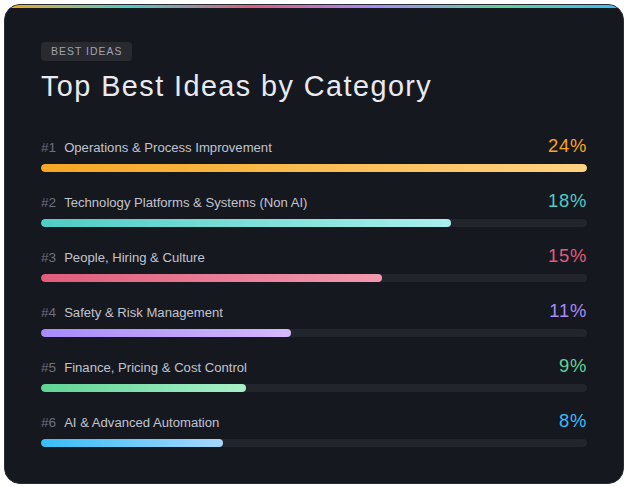
While burning issues highlight areas of pain, best ideas represent the solutions leaders are actively implementing. Every Study Groups meeting includes time for participants to share a high-impact idea they have recently put into practice. These ideas often serve as catalysts for meaningful improvement.
The data shows that the most common categories of best ideas align closely with the most prevalent burning issues. Technology and systems, people and staffing, and operations and processes dominate both sides of the discussion. This alignment suggests that leaders are not only identifying their biggest challenges but also responding with practical, actionable solutions.
In technology, best ideas often focus on breaking down large, complex system challenges into manageable improvements. Examples include targeted dashboards, AI tools, integrations, and automation initiatives that create incremental progress and learning, even while broader ERP or POS transformations remain frustrating.
In people, operations, and safety, the breadth of ideas reflects a healthy organizational instinct. When faced with constraints such as capital limitations, vendor dependencies, or legacy platforms, leaders tend to focus on areas within their direct control. Improvements in hiring, training, culture, and process discipline serve as practical responses to real operational pressures.
Recent Activities: Common Themes
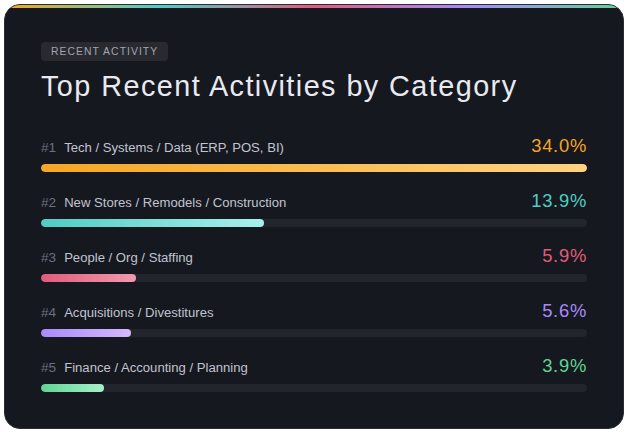
Roughly one quarter of recent activities shared were highly specific to individual organizations, while approximately 75% reflected clear, recurring themes. After the top 5, the remaining activities touched on areas such as food service, operations, marketing, insurance, and safety. Among the dominant themes, Technology and Growth emerged as the most prevalent.
Across all meetings, technology and systems work surfaced as the most frequently discussed area of recent activity. Leaders commonly referenced ongoing ERP and platform transitions, enhancements to reporting and analytics, and infrastructure changes such as hosting adjustments and software migrations. These updates reflect a strong focus on building foundational systems. Many organizations appear to be operating legacy processes in parallel with new implementations, indicating a prolonged transition phase. Overall, this points to sustained investment in core platforms and data capabilities as leaders work toward longer-term operational alignment.
Physical expansion and reinvestment represent another major area of focus. Leaders regularly shared updates related to new store openings, ground-up construction, remodels, and facility expansions. These projects span a wide range of assets, including warehouses, offices, car washes, bakeries, and travel centers. The combination of new builds and upgrades to existing facilities suggests that organizations are pursuing growth while simultaneously modernizing their footprint. This activity reflects a dual emphasis on market presence and operational capacity, underscoring a continued commitment to improvement and expansion.
Closing Perspective
Thousands of hours of peer discussion reveal leaders navigating real tension together. While the challenges are significant, the best ideas data offers an encouraging signal. The same categories generating the most pain are also producing the most tangible solutions. This reinforces the value of the Study Groups model, which brings experienced operators together in a trusted environment to focus on issues and ideas that truly matter.