By Dr. David Nelson
Four years ago, electric vehicles seemed an unstoppable force in the American car market. California and the U.S. government announced a timetable to ban the sale of gas-powered cars. EV sales were climbing each quarter, automakers were racing to launch new models, and forecasters were debating not whether EVs would take over, but how fast. Today, the picture is far more complicated. Battery-electric vehicle (BEV) sales have plateaued and even reversed over the past year, while a different kind of electrified vehicle, the humble gas-electric hybrid, has quietly become the industry’s fastest-growing segment. Understanding how the U.S. got here requires looking at four distinct phases: steady growth, a policy-driven sprint, a sharp drop-off, and an uneasy stabilization.
Phase One: Steady Climb (2022–2023)
In 2022, EVs and hybrids together made up about 12.9% of new light-duty vehicle sales in the United States, according to the U.S. Energy Information Administration (EIA). By the second quarter of 2023, that combined share had reached roughly 16%, with battery-electric vehicles alone accounting for about 7% of the market. This was the era of the Inflation Reduction Act’s Clean Vehicle Credit, which offered buyers up to $7,500 off qualifying new EVs and helped lower prices. Manufacturers responded by aggressively expanding their lineups: EIA data show that the number of available battery-electric models jumped from 34 to 55 between 2021 and mid-2023, even as the number of traditional gasoline models shrank. Much of this early growth was concentrated in the luxury segment, where battery-electric vehicles accounted for roughly a third of sales, compared with barely more than 1% in the non-luxury market. Tesla dominated, but competitors including Ford, Chevrolet, Hyundai, and Kia began chipping away at its share.
Growth continued throughout the rest of 2023. By the third quarter, the combined electrified-vehicle share had reached a then-record 17.7%, and EV sales for the year topped 1.2 million units, giving battery-electric vehicles a 7.6% share of the full-year market, up from 5.9% in 2022.
Phase Two: The Sprint Toward a Deadline (2024–Mid-2025)
Growth accelerated through 2024 and into 2025, driven by two overlapping forces: greater model choice and, eventually, urgency. Combined hybrid, plug-in hybrid, and battery-electric sales rose to roughly 18.7% of the market by the second quarter of 2024, then to a record 21.2% by the third quarter, as EIA data show BEV sales climbing from about 7.1% to nearly 9% of the market in a single quarter. Plug-in hybrids also grew steadily, if modestly, rising from around 1.7% to 2.0% of sales year over year.
For the full year 2024, electrified vehicles — hybrids, plug-ins, and full battery-electrics combined — reached 20% of new car and truck sales for the first time, with gas and diesel vehicles falling under 80% of the market for the first time in the modern era, according to reporting based on Motor Intelligence data. Roughly 1.3 million were all-electric models, and 1.9 million were hybrids of some kind. Tesla’s share of the EV market continued to slide, down to about 49% from 55% the year before, as Hyundai/Kia, General Motors, and Ford all built out competing lineups.
The real turning point came in the second half of 2025. With the federal EV tax credits set to expire on September 30, 2025, buyers rushed to lock in savings before the deadline. Battery-electric vehicles hit a record 12% share of light-duty sales that September, and combined electrified-vehicle share peaked at 27.5% in the third quarter of 2025 — the high-water mark of the entire four-year period. This was less a sign of durable demand than a classic pull-forward effect: consumers who might have bought an EV in 2026 instead bought one in September 2025 to beat the deadline.
Phase Three: The Drop-Off (Late 2025–Early 2026)
The consequences of that pull-forward became clear almost immediately. Once the tax credits lapsed, battery-electric sales fell sharply. By the fourth quarter of 2025, EV volume and share were both declining, and the slide continued into early 2026. Combined electrified-vehicle share, which had peaked near 27.5%, fell to roughly 22% by late 2025 and recovered only slightly to 22.7% in the first quarter of 2026. For the full year 2025, EIA estimates put the combined share of hybrids, battery-electrics, and plug-in hybrids at about 22%, up from 20% in 2024, but with a composition shifting away from pure electrics. Notably, 2025 marked the first year that annual battery-electric sales and market share declined year over year, after a decade of steady gains.
The luxury EV segment, long the strongest pocket of demand, was hit especially hard. Battery-electric share of luxury sales fell from about 22% to 14% year over year by the second quarter of 2026, reflecting a broad pullback even among buyers most willing to pay a premium for electric drivetrains.
Automakers that had bet on EVs as their future found themselves with growing inventories of unsold vehicles and were forced to pivot back to ICE vehicles. GM took a $5 billion hit, Ford wrote off $16 billion, Honda $9 billion, and Stellantis $26 billion. Toyota, which had smartly bet on hybrid vehicles, was criticized for being slow to jump on the electric-vehicle bandwagon. Toyota had planned to introduce a new flagship all-EV Lexus and to make the entire brand all-electric by 2035. In May, Toyota abandoned its electrified Lexus “in light of the surrounding environment.”
Phase Four: Stabilization Around a New, Lower Plateau (2026)
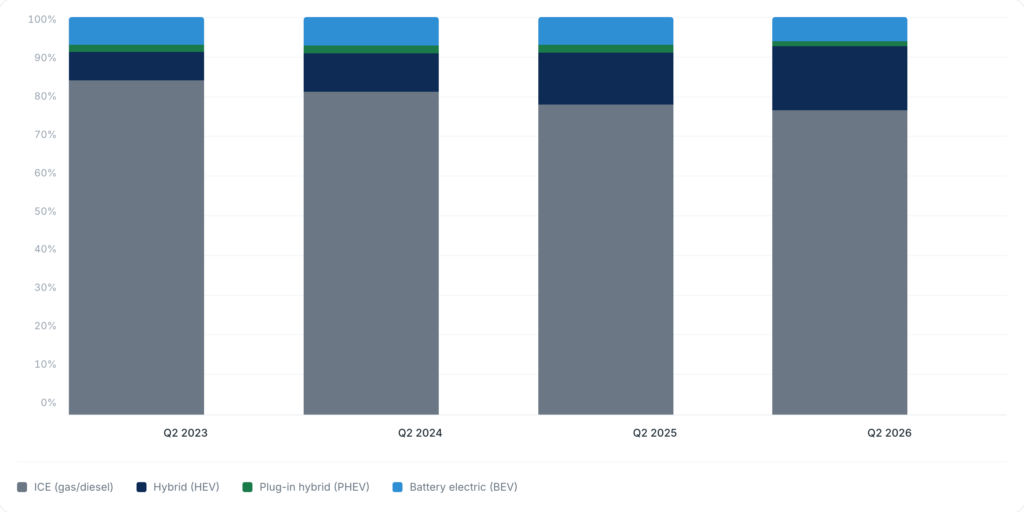 By the second quarter of 2026, the market had settled into a new, lower equilibrium for pure EVs. Battery-electric vehicles accounted for about 6% of new light-duty vehicle sales, down from 7% a year earlier, while plug-in hybrids slipped to 1.4% from 1.9%. Cox Automotive data tell a similar story: EV volume was essentially flat quarter over quarter in early 2026 but still down about 20% year over year, even as new, more affordable models began entering the market to help slow the decline.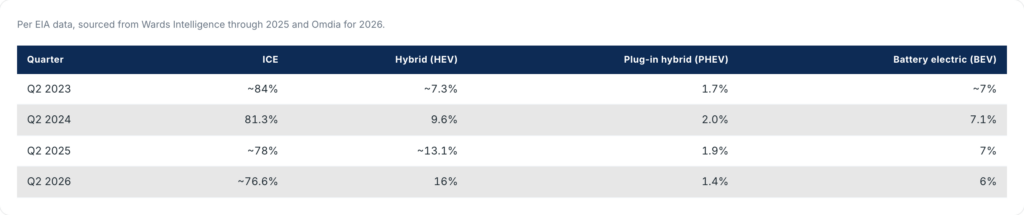
What changed the overall electrified-vehicle trajectory in 2026 wasn’t EVs at all — it was hybrids. Conventional gas-electric hybrids, which never depended on the federal tax credit, grew to a record 16%–18% of new-vehicle sales in the second quarter of 2026, up sharply from roughly 7% just three years earlier. Combined electrified-vehicle share (hybrids, plug-ins, and BEVs together) climbed back to about 24–27% of the market, depending on the data source, but the composition had flipped: hybrids now outsell battery-electrics and plug-in hybrids combined by nearly two to one. Elevated gasoline prices, expanding hybrid-only nameplates from automakers like Toyota and Jeep, and continued affordability concerns around EVs all contributed to this shift. Industry forecasts from JD Power and GlobalData describe a similar divergence in manufacturer incentive spending — dollars flowing toward ICE and hybrid vehicles have risen sharply, while EV incentives have shrunk, even as EV sticker prices remain harder to finance amid rising subprime lending and longer loan terms.
The Bigger Picture
Zooming out, the four-year arc looks less like a straight line toward electrification and more like a boom-bust-adjustment cycle heavily shaped by policy. Combined electrified-vehicle sales grew substantially, from roughly 13–16% of the market in 2022–2023 to the low-to-mid 20s by 2026, but nearly all of the net gain over the past year came from hybrids rather than plug-in vehicles. Battery-electric vehicles, meanwhile, remain a small fraction of the vehicles actually on U.S. roads: even after years of sales growth, EVs made up only about 2% of all registered light-duty vehicles as of 2024, since new sales take years to meaningfully reshape the existing fleet.
Whether the current hybrid-led pattern is a temporary detour or a longer-term recalibration remains an open question. Some forecasts see hybrids continuing to grow toward roughly a third of passenger-vehicle sales by the mid-2030s, while the next wave of lower-cost EV models — expected in late 2026 and 2027 — will be an important test of whether battery-electric demand can rebuild without the cushion of a federal tax credit. In the meantime, consumers are hedging their bets, with 92.6% of all vehicles sold in the U.S. in the second quarter of 2026 powered solely by fossil fuels.