Editor’s note: This content was first published on Capital One Commercial Insights.
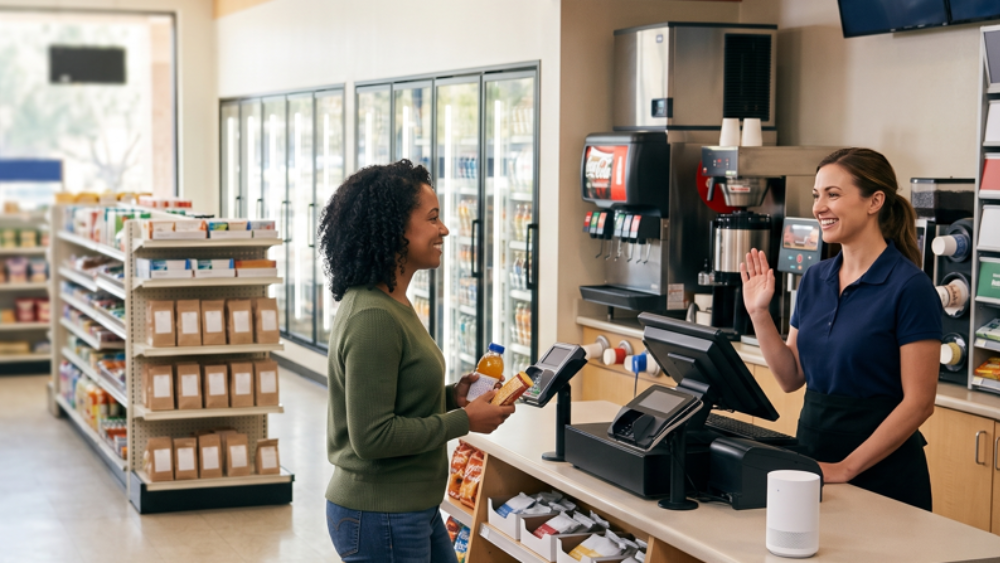
Fuel and convenience store operators in the U.S. are enjoying a period of strength and resilience, boosted by a number of positive trends. The pressure of rising operating costs has begun to moderate as U.S. inflation has returned to a more normal range. Expanded offerings, including more food options, continue to boost the bottom line.
Lower capital costs are also helping the industry by encouraging M&A activity and bringing healthy consolidation, and a steady pace of new store builds.
“These are important trends that our team has been watching closely,” says Jason Noll, leader of the Convenience & Gas Banking group at Capital One. “The heart of the matter is how retailers attract traffic into their stores, what they sell to those customers and the margins on those sales. More and more, that comes down to things like made to order food, bean to cup coffee and loyalty programs that are becoming a real competitive advantage.”
Fuel sales volume is often used as a marker for customer traffic to fuel and convenience store businesses—a proxy for the site visits that create opportunities for those higher-margin in-store sales. But volumes often tell an incomplete story, according to Noll.
Understanding fuel volumes
Indeed, overall retail fuel sales volumes in the U.S. have plateaued in recent years at just under 9 million barrels a day, according to data from the Energy Information Administration (EIA). At the same time, the convenience retail sector continues to grow and evolve. Inside-store sales grew every year for more than two decades, according to data from the National Association of Convenience Stores (NACS), a convenience and fuel retailing industry group. Food sales now account for roughly 40% of in-store gross margin dollars.
Developments that might impact fuel volumes attract attention. One of these is the growth in sales of more efficient hybrid gas-electric cars and electric vehicles (EVs). While this has the potential to fundamentally change the gas and convenience segment, rising fuel efficiency and electrification are trends that are unfolding gradually.
John Eichberger, executive director of the Transportation Energy Institute, a nonprofit research group, recently spoke at a webinar hosted by Capital One. He noted that more than 90 percent of new vehicles sold in the U.S. still use liquid fuel. Hybrids are increasing their market share significantly, and outpacing the growth in EVs, which remain more of a niche luxury purchase. Electrification of transportation in the U.S. is still in the early stages and policy-dependent, Eichberger says.
Evolution of the business model
The energy transition is real—but it doesn’t threaten a sudden disruption of the gas and convenience store model. Eichberger estimates that even in a scenario that assumes relatively fast change in car buyer behavior, 40 percent of vehicles in operation in 2050 will still have an internal combustion engine. “Any change in new vehicle purchases is going to take 15 to 20 years to be reflected in half of the vehicles on the road,” he said on the webinar.
The industry can successfully evolve in response to changes such as rising fuel efficiency and electrification, as it has responded to previous changes. For example, over several decades, the classic service station receded, and the combined fuel and convenience store model became dominant. Convenience stores are almost becoming more of a destination than a necessary stop for fuel, Noll points out.
Fuel prices
Another factor to consider is the jump in fuel prices caused by the Iran conflict and the squeeze in global oil markets. The average retail price of gasoline in the U.S. was above $4 a gallon in early April, up from less than $3 before the start of the conflict.1
Persistently high fuel prices have the potential to impact fuel volumes, but in the near-term, the effect of fuel prices can be mixed for fuel and convenience store operators. Price volatility can be a positive for these businesses, and the industry has long existed in a changing landscape of fuel prices.
Even if higher prices last and begin to influence driver choices, pushing them to more fuel efficient cars, for example, it might not translate into fewer visits to stores. Some people might stop at the pump more often if the dollars they budget for fuel buy less. Others might find that smaller gas tanks on fuel efficient vehicles keep them coming back.
Over time, electrification could prove to be a positive for gas and convenience stores—if they add chargers and have customers in their stores for longer while they wait for batteries to fill.
Ultimately, the successful evolution of the business in coming decades will only reinforce the importance of store design, customer experience, and the right mix of in-store offerings.
Learn how Capital One’s Commercial Banking team helps businesses navigate evolving industry trends. Contact Jason Noll, below, to find out more.